Hexa: A Bold, Modern Display Font for Crafters & Sellers
If you've ever spent hours tweaking letter spacing on a candle label only to find it still looks “off,” or agonized over whether your wedding welcome sign reads as elegant—or just busy—then Hexa is the display font that finally clicks. As someone who designs printable planners, cuts vinyl decals for boutique gift tags, and ships hundreds of hand-stamped greeting cards each season, I don’t reach for fonts based on trends—I reach for ones that work. Hexa works. It’s cool without being cold, bold without being overwhelming, and modern without sacrificing warmth.
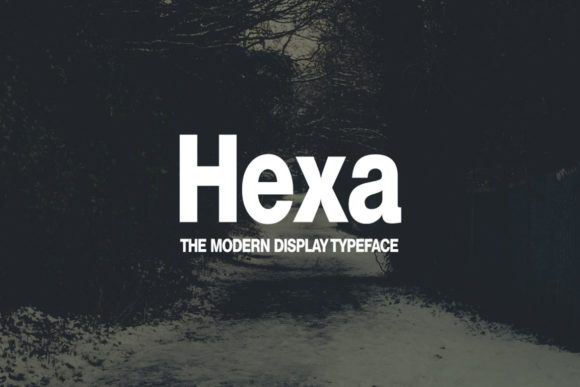
Visually, Hexa lands somewhere between confident minimalism and approachable energy. Its clean lines, balanced proportions, and subtle geometric structure give it strong legibility at any size—even when scaled down to 8pt on a tiny product tag or blown up across a 24"x36" farmhouse-style wall art print. There’s no excessive ornamentation, no distracting serifs or dramatic swashes—just intentional, well-drawn letterforms that hold their own in both digital mockups and physical production.
That simplicity is exactly why Hexa shines across so many handmade applications. On kraft paper candle labels? Crisp and trustworthy. On glossy sticker sheets for planner inserts? Sharp and vibrant. On heat-transfer vinyl for tote bags or tees? Clean edges cut cleanly on Cricut and Silhouette machines—no jagged corners or unexpected overlaps. I’ve used it for seasonal packaging (think mint-green holiday soap boxes with gold foil Hexa titles), rustic wedding signage (a chalkboard-style welcome board where Hexa’s weight balances handwritten calligraphy accents), and even ceramic mug decals—where its sturdy x-height ensures readability after kiln firing.
For printable creators, Hexa is especially versatile in title treatments and focal points. Use it for section headers in digital planners, cover text on Canva-ready invitation suites, or bold quotes in downloadable wall art bundles. Because it’s designed as a display font—not body text—it’s not meant for long paragraphs, but it excels where attention needs to land: product names on Etsy listings, shop banner headers, SVG layer labels in design files, or featured phrases in social media graphics. Its clarity translates beautifully across devices, so your Instagram Story preview looks as polished as your final PDF download.
Readability in real-world production matters just as much as aesthetics. Hexa performs reliably on small surfaces: I’ve printed it at 6mm tall on adhesive backing labels for bath bomb jars, and it remained crisp under magnification. For cutting machines, the open counters (like inside the 'e' or 'a') prevent fill-in during weeding, and consistent stroke weights reduce risk of breakage on fine details. When prepping files for print-on-demand partners like Printful or Gelato, Hexa converts smoothly to outlines—no missing glyphs or font substitution surprises.
Pairing Hexa thoughtfully elevates your entire brand identity. Try it with a relaxed script font—like a soft brush script—for “Hand-Poured” or “Est. 2022” sublines beneath a bold Hexa product name. Or contrast it with a gentle serif (think Garamond or Cormorant) for wedding invitations where Hexa handles names and headings while the serif carries ceremony details. For minimalist packaging, pair it with a neutral sans serif (like Montserrat or Inter) in lighter weights—creating hierarchy without visual competition.
Before downloading, check what’s included: most premium versions of Hexa offer OpenType features like stylistic alternates, standard ligatures, and multilingual support (including extended Latin characters)—handy if you sell globally or create bilingual baby shower invites. File formats typically include OTF and TTF, compatible with Adobe Creative Suite, Cricut Design Space, Silhouette Studio, and free tools like Inkscape or Canva. No need to hunt for web-optimized WOFF files unless you're embedding Hexa into an online shop theme—but for physical products and digital downloads, the desktop formats are all you’ll need.
Crucially, Hexa is licensed for commercial use—meaning you can confidently use it in client projects, sell SVG files containing Hexa-based designs, bundle it into editable Canva templates, print it on merchandise, or feature it on product packaging sold through Etsy, Shopify, or local markets. Just verify your license covers the scope: most standard licenses permit unlimited physical product runs and digital resale of end-user deliverables (like printable PDFs), but prohibit reselling the font file itself or embedding it in apps or SaaS platforms. When in doubt, review the EULA—but for crafters building real businesses, Hexa’s licensing is refreshingly straightforward and seller-friendly.
I keep Hexa in my go-to folder alongside my favorite ink colors and most-used cutting mats—not because it’s flashy, but because it solves problems. It makes “Small Batch • Handmade Since 2019” look intentional on a linen tea towel tag. It gives “Happy Birthday!” the joyful weight it deserves on a layered card cut. It helps customers instantly recognize your brand across stickers, labels, and social posts—not through gimmicks, but through consistency and clarity. That’s the quiet power of a well-designed display font: it doesn’t shout, but it makes sure you’re heard.
Whether you're designing your first Etsy listing or your hundredth seasonal collection, Hexa isn’t just another font in your library. It’s the steady hand behind your boldest ideas—the typeface that says “this was made with care,” before anyone even reads the words.